


- General Information
- Project summary
- Main results (Stage I)
- Cognitive and socio-economic impact
- Disemination
Additive manufacturing of a blisk for gas turbines used in aerospace applications
Project code: PN-IV-P2-2.1-TE-2023-1776
Contract no.: 141TE/26.08.2025
Programme: 5.2 – Human Resources (Young Research Teams)
Contracting authority: Executive Agency for Higher Education, Research, Development and Innovation Funding (UEFISCDI)
Duration: 24 months (26.08.2025 – 26.08.2027)
Consortium:
CO – National Research and Development Institute for Gas Turbines COMOTI, Bucharest, Romania
Total budget: 473,682 RON
Public funding: 473,682 RON
Director Proiect (CO):
Dr. Eng. Alexandru Paraschiv, INCD Turbomotoare COMOTI
Research Team Members
• Alexandru Paraschiv – Project Leader
• Gheorghe Matache – Researcher Member
• Oana Dumitrescu – Postdoctoral Member
• Răzvan Catană – Postdoctoral Member
• Mihaela Raluca Condruz – Postdoctoral Member
• Răzvan Nicoară – Researcher Member
• Daniel Useriu – PhD Student Member
• Teodor Adrian – Researcher Member
Main objective of the AMBLISK project
The main objective of the AMBLISK project is to perform experimental and theoretical research on the application of metal additive manufacturing by Laser Powder Bed Fusion (L-PBF) and the integration of internal lattice structures to obtain an IN718 blisk (integrally bladed disk) with reduced mass and improved performance. The blisk is intended for small high-speed gas turbines used in aerospace and related propulsion applications.
Current development trends in the aerospace sector require significant weight reduction of components in order to increase energy efficiency, reduce emissions and fuel consumption, and shorten production time and cost. Turbine rotors can be manufactured either as a classical “disk + blades” assembly or as an integrated rotor with blades (blisk). The blisk configuration reduces the number of components, simplifies assembly and can decrease the mass of the rotor by approximately 20–30%, with a direct impact on fuel consumption and overall efficiency.
However, conventional manufacturing methods (forging, extensive machining, welding) are strongly limited by the complex geometry, small dimensions and tight tolerances of modern blisks, and typically require high buy-to-fly ratios on the order of 20:1–40:1, leading to long and expensive processes, including repairs.
Additive manufacturing (AM) by L-PBF eliminates many of these limitations, enabling complex geometries and lightweight internal lattice structures with drastically reduced material waste (typical 1:1–3:1 material usage) and shorter lead times and costs. Integrating lattice structures in the massive regions of the hub further reduces mass, optimises the strength-to-weight ratio and can improve the dynamic behaviour of the rotor.
Combining a high-temperature nickel-based superalloy such as IN718 with an internally optimised architecture allows the development of a turbine rotor adapted to the requirements of new generations of gas turbines and advanced propulsion systems.
During Stage I, the activities focused on preliminary design of the blisk, numerical simulations (CFD and FEA), topology optimisation and definition of the testing matrix.
• A preliminary 3D CAD model of the blisk was developed based on the thermogasodynamic cycle of a reference micro gas turbine (AMT Titan). The geometry was validated through numerical simulations in relevant operating conditions.
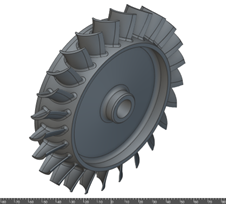
Figure 1. A preliminary 3D CAD model of blisk
• CFD analyses were performed to evaluate pressure and velocity distributions in the turbine stage, and the results were used to define the loading cases for the structural FEA of the rotor (Figure 2).
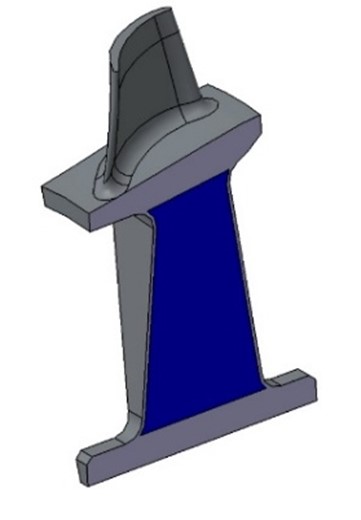
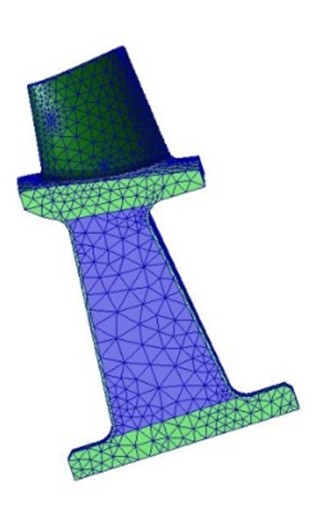
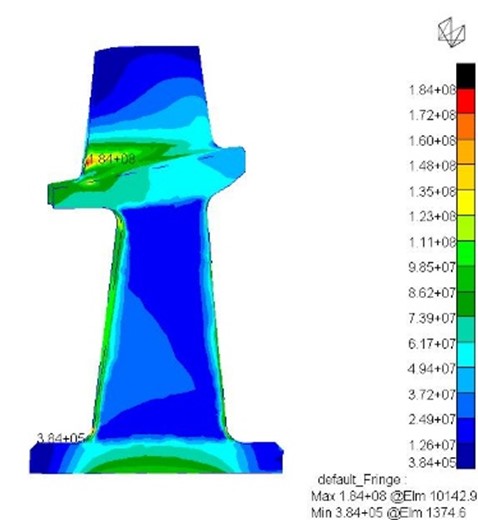
Figure 2. Representations of the part geometry (rotor sector), the FEM model, and the Von Mises stress distribution
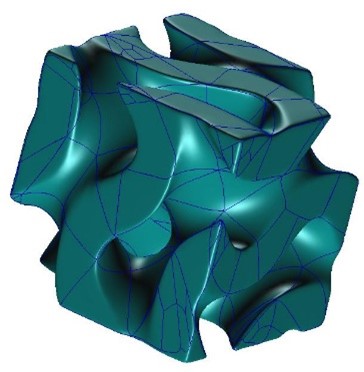
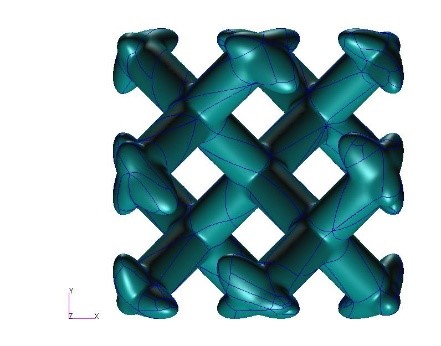
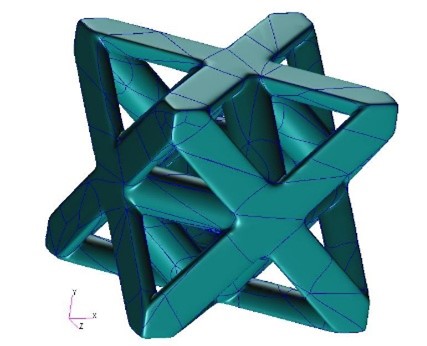
• Design and non-design volumes were defined, together with the optimisation objectives (increased stiffness, reduced mass) and mechanical/functional constraints. Topology optimisation targeted mass reduction by implementing lattice structures (gyroid, diamond and octet – Figure 3) in the hub region while preserving all functional areas (blades, flow channels, sealing and interfaces). The static and vibrational behaviour of the lattice-reinforced configurations was evaluated numerically and compared with the solid reference solutionto identify changes in stiffness and natural frequencies relevant for small turbine operation.
a) b) c)
Figure 3. Graphical representation of lattice unit cells: (a) gyroid, (b) diamond and (c) octet.
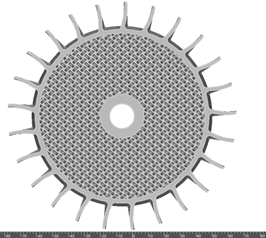
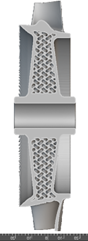
Figure 3. Transverse and longitudinal sections of the blisk with an internal gyroid lattice structure
• In parallel, a test matrix was established for optimisation of the L-PBF process and for material and lattice characterisation. The matrix includes mechanical testing of IN718 specimens and lattice structures, as well as exposure to aggressive environments (high-temperature oxidation and corrosion).
• Additional testing and validation directions were defined, including complex geometries and hybrid L-PBF–DED processes, in order to determine optimal parameters for dimensional reconstruction and improved surface quality.
Cognitive impact of the AMBLISK project
The cognitive impact of the AMBLISK project is mainly related to:
• New knowledge on L-PBF IN718 blisks with lattice structures – investigation of the relationships between process parameters, defects, microstructure and mechanical/dynamic behaviour of lightweight, lattice-reinforced turbine rotors.
• Interdisciplinary expertise – strengthening competences at the interface between materials science, additive manufacturing, turbomachinery design and aerospace engineering within COMOTI.
• Development of advanced design and numerical simulation methodologies – integration of topology optimisation, lattice design and multi-physics simulations (CFD and FEA) into a coherent workflow for turbomachinery components.
• Training of young researchers – involvement of young engineers and PhD students in design, AM process development and experimental characterisation, contributing to the formation of a new generation of specialists in Romania in metal AM for aerospace applications.
Socio-economic impact
The socio-economic impact of the project is expected at several levels:
• Increased competitiveness of the Romanian aerospace sector – by developing local capabilities for the design and additive manufacturing of critical rotating components (blisks) using advanced nickel-based superalloys.
• Stronger local research ecosystem – the project consolidates COMOTI’s role as a national centre for metal additive manufacturing, enabling future collaborations in European programmes and with industry, and creating high-skill jobs in advanced manufacturing and design.
• Improved efficiency and sustainability – lightweight blisks with optimised strength-to-weight ratios can contribute to reduced fuel consumption, lower emissions and lower life-cycle environmental impact of small gas turbines and UAV propulsion systems.
• Reduced material waste – L-PBF drastically decreases material losses compared to conventional subtractive methods, which is particularly important for costly aerospace materials like IN718.
• Support for innovation and technology transfer – the infrastructure, methodologies and know-how developed in the AMBLISK project can be transferred to industrial partners for new products and services in aerospace and related sectors (energy, automotive, turbomachinery).
• Alignment with European strategic priorities – the project contributes to EU objectives on advanced manufacturing, digitalisation and sustainable, efficient propulsion systems by demonstrating the feasibility of additively manufactured turbomachinery components for aerospace applications.
Scientific papers in preparation
Scientific papers are currently being prepared, with the following main topics:
(i) Design, simulation and experimental validation of L-PBF lattice structures for lightweight, high-performance components.
(ii) Optimisation of L-PBF process parameters for IN718 to achieve high density and robust mechanical properties.